
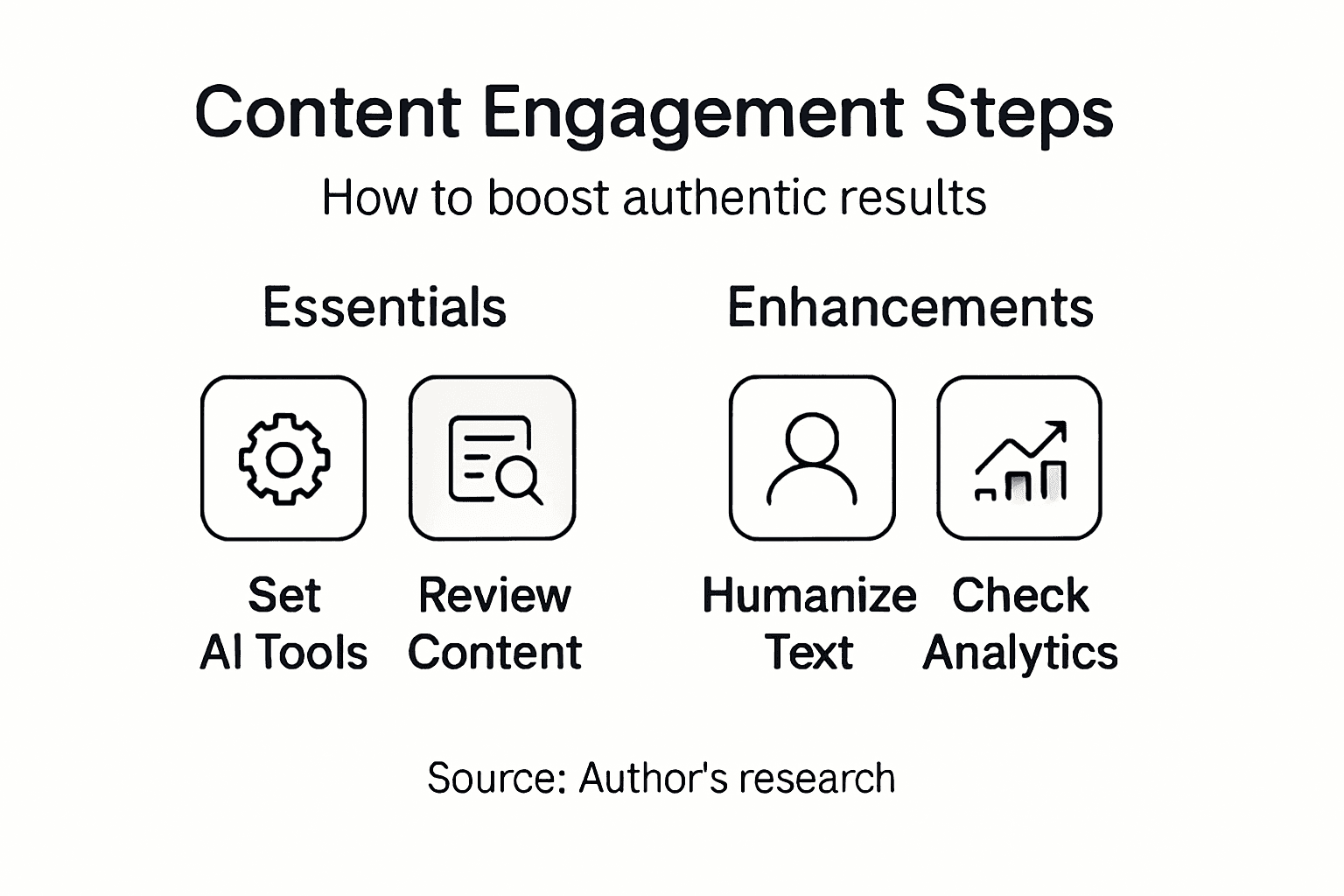
Every content marketer knows the challenge of keeping global audiences truly engaged while juggling speed, originality, and brand authority. As AI content tools become central to daily workflows, knowing how to set them up for maximum impact can redefine not just productivity but authenticity, too. This guide breaks down clear action steps for integrating and humanizing AI-driven content, making your strategy more relevant, readable, and measurable at every stage.
Table of Contents
- Step 1: Set Up AI Content Tools for Maximum Impact
- Step 2: Assess Existing Content for Engagement Gaps
- Step 3: Apply Humanizing Enhancements with Advanced Rewriting
- Step 4: Optimize Layout and Readability for Audiences
- Step 5: Verify Engagement with Real-Time Analytics
Quick Summary
| Key Point | Explanation |
|---|---|
| 1. Identify Content Needs First | Start by understanding your content goals to choose the right AI tools for productivity enhancement. |
| 2. Assess Engagement Gaps Regularly | Analyze content performance and user interaction to discover areas needing improvement in audience engagement. |
| 3. Humanize AI Content Effectively | Use advanced rewriting techniques to transform AI-generated content into authentic, relatable text. |
| 4. Optimize Layout for Readability | Ensure strategic formatting and design to make content visually accessible and engaging for readers. |
| 5. Utilize Real-Time Analytics | Implement comprehensive analytics to monitor engagement metrics and understand audience behavior effectively. |
Step 1: Set Up AI Content Tools for Maximum Impact
Setting up AI content tools requires strategic planning and understanding of your specific workflow. These tools can transform how you create, edit, and optimize content across multiple platforms by providing intelligent assistance and enhancing productivity.
To maximize impact, start by identifying your primary content needs and selecting AI tools that align with those requirements. Understanding AI’s transformative potential helps streamline your content creation process. Consider the following key steps:
- Evaluate your current content workflow
- Research AI tools specific to your industry
- Test multiple platforms before committing
- Understand each tool’s unique capabilities
When integrating AI content tools, focus on platforms that offer:
Here is a comparison of common AI content tool features and their potential business impact:
| Feature | Benefit to Workflow | Potential Business Impact |
|---|---|---|
| Natural Language Processing | Enhances text accuracy | Reduces editing time |
| Contextual Understanding | Improves content relevance | Increases audience engagement |
| Robust Editing Capabilities | Streamlines review process | Accelerates publishing |
| Plagiarism Detection | Ensures originality | Protects brand reputation |
- Advanced natural language processing
- Contextual understanding capabilities
- Robust editing and refinement features
- Plagiarism and authenticity checks
Successful AI tool implementation requires a balanced approach that combines technological efficiency with human creativity.
Pro tip: Start with free versions or trial periods to understand each tool’s strengths before making a financial commitment.
Step 2: Assess Existing Content for Engagement Gaps
Identifying engagement gaps requires a systematic approach to understanding how your current content resonates with your target audience. Evaluating research engagement frameworks helps pinpoint areas where your content might be falling short of audience expectations.
To thoroughly assess your content’s engagement potential, follow these critical evaluation steps:
- Analyze current content performance metrics
- Review audience interaction data
- Identify topics with low engagement rates
- Compare content against competitor benchmarks
Start by examining key performance indicators that reveal audience connection:
- Average time spent on page
- Social media share rates
- Comment and interaction volumes
- Bounce rates for specific content types
Engagement analysis involves more than just numbers. You need to understand the qualitative aspects of why certain content attracts or repels your audience. Uncovering content gaps requires deep insights into audience preferences and unmet informational needs.

Use this summary table to understand key differences between quantitative and qualitative engagement analysis:
| Approach | What It Measures | Typical Tools | Business Value |
|---|---|---|---|
| Quantitative | Numbers and usage metrics | Analytics platforms | Track audience growth |
| Qualitative | Audience opinions, feedback | Surveys, interviews | Discover unmet content needs |
Effective content engagement is about creating meaningful connections that transform passive readers into active participants.
Pro tip: Conduct periodic audience surveys to gather direct feedback about your content’s perceived value and relevance.
Step 3: Apply Humanizing Enhancements with Advanced Rewriting
Transforming AI-generated content into authentic, natural-sounding text requires strategic rewriting techniques that preserve the core message while adding human nuance. Advanced AI humanization strategies can help you bridge the gap between machine-generated and human-crafted content.
To effectively humanize your content, focus on these critical enhancement strategies:
- Adjust sentence structure and rhythm
- Incorporate natural language variations
- Add contextual depth and personal insights
- Eliminate repetitive or robotic phrasing
Begin your rewriting process by addressing key humanization elements:
- Break up overly complex sentences
- Introduce conversational tone
- Remove generic or predictable language patterns
- Inject subtle personal perspective
Rewriting techniques go beyond simple word substitution. From robotic to readable content requires a nuanced approach that captures the subtleties of human communication.
Authentic writing is not about perfection, but about connecting genuinely with your audience.
Pro tip: Read your rewritten content aloud to identify and eliminate any remaining mechanical language patterns.
Step 4: Optimize Layout and Readability for Audiences
Creating content that captures and maintains audience attention requires strategic design and thoughtful formatting. Designing accessible and readable documents involves more than just writing compelling text – it’s about creating a visual experience that guides readers effortlessly through your content.
To enhance your document’s readability and engagement, implement these critical layout strategies:
- Use clear, hierarchical headings
- Create generous white space
- Break text into digestible paragraphs
- Incorporate visual elements like lists and graphics
Focus on these specific layout optimization techniques:
- Select readable font styles and sizes
- Maintain consistent formatting
- Use strategic text highlighting
- Balance text density with visual breathing room
Visual clarity techniques transform complex information into easily consumable content. Plain language formatting strategies help make your documents less intimidating and more engaging.
Effective layout is the silent communicator that guides your reader’s journey through information.
Pro tip: Test your document’s readability by asking someone unfamiliar with the content to quickly scan and explain its key points.
Step 5: Verify Engagement with Real-Time Analytics
Tracking content performance requires sophisticated analytics that provide immediate insights into audience interaction. Learning engagement analytics enable you to understand how your audience connects with your content in real-time.
To effectively monitor content engagement, implement these critical tracking strategies:
- Configure comprehensive analytics dashboards
- Set up custom engagement metrics
- Track user behavior and interaction patterns
- Monitor time spent and scroll depth
Focus on these specific analytics verification techniques:
- Identify key performance indicators
- Compare engagement across different content types
- Analyze user interaction heat maps
- Review audience segmentation data
Performance tracking methods transform raw data into actionable insights. Real-time engagement systems help you understand audience behavior beyond surface-level metrics.
Analytics are not just numbers – they are stories about how your audience experiences your content.
Pro tip: Cross-reference multiple analytics platforms to ensure comprehensive and accurate engagement measurement.
Unlock Authentic Content Engagement with Hukhta’s AI Tools
The challenge of turning AI-generated writing into natural, engaging content that truly connects with your audience is clear in the guide “Improve Content Engagement Guide for Authentic Results.” You want to move beyond robotic text, overcome engagement gaps, and optimize readability without spending hours rewriting. Hukhta.com offers powerful solutions to address these pain points through advanced AI-powered rewriting and humanizing features designed to capture authentic voice and boost SEO performance. Our platform supports over 120 languages and provides seamless paraphrasing and summarization tools that reduce editing time and improve audience interaction.
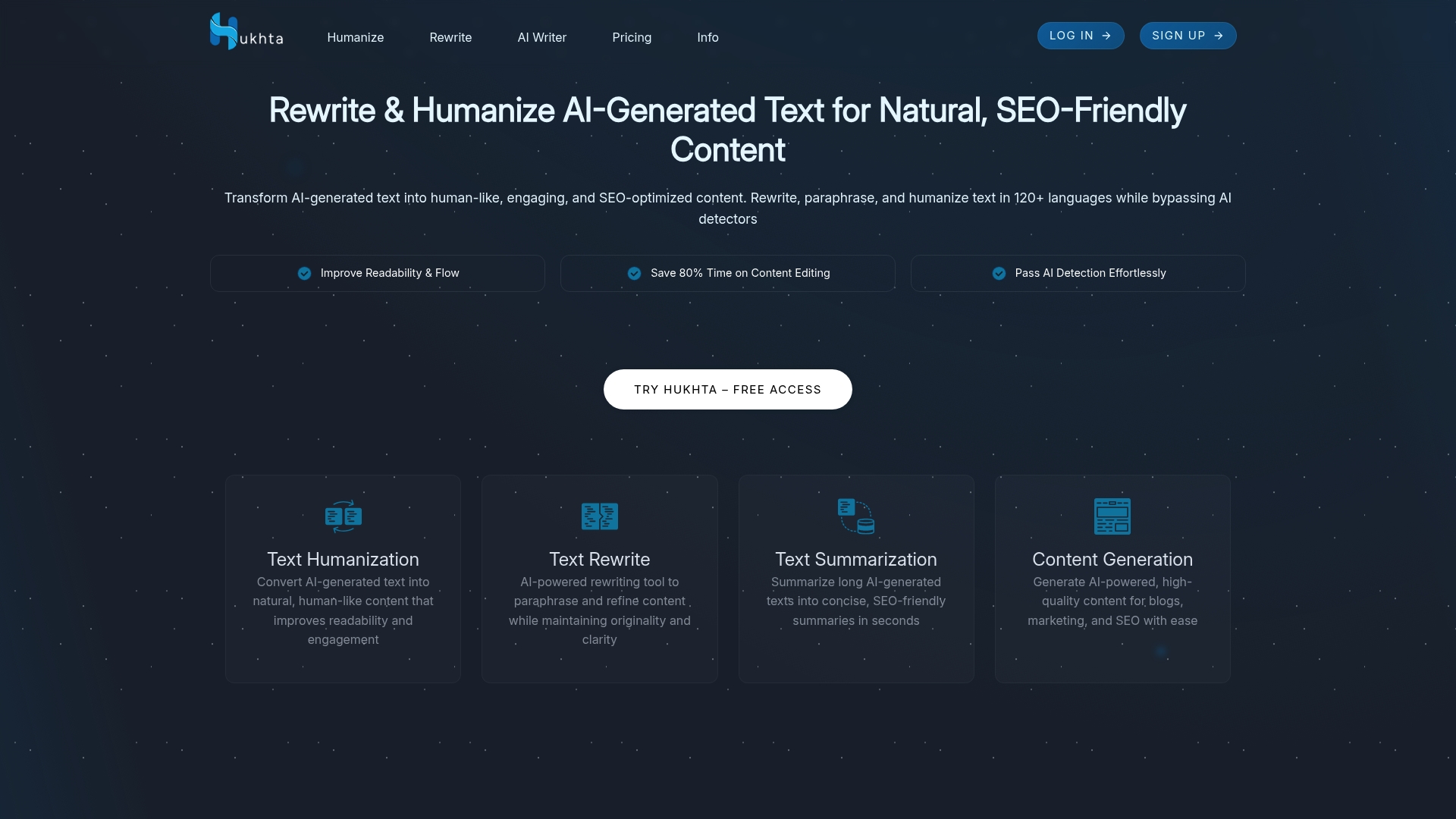
Experience the transformative effect of Hukhta on your content workflow. Start enhancing your AI content today with tools built for real human connection and professional polish. Visit Hukhta.com now and explore how you can rewrite, humanize, and optimize AI content effortlessly. Take your engagement strategy to the next level with advanced rewriting solutions that make your content not only readable but genuinely captivating.
Frequently Asked Questions
How can I identify engagement gaps in my content?
To identify engagement gaps, analyze your current content performance metrics, such as average time spent on page and social media shares. Review audience interaction data and compare your content against competitor benchmarks to understand where you might be falling short.
What are the key steps to optimize my content layout for better readability?
To optimize your content layout, use clear headings, break text into short paragraphs, and incorporate visual elements like lists and graphics. Aim for a design that creates generous white space, making it easier for readers to navigate your content.
How do I effectively apply humanizing enhancements to AI-generated content?
To humanize AI-generated content, adjust sentence structures, incorporate natural language variations, and add contextual depth. Eliminate robotic phrasing to create a more authentic and relatable voice for your audience.
What are some important performance metrics to track for content engagement?
Key performance metrics include time spent on page, bounce rates, and social media share rates. Set up analytics dashboards to track these metrics regularly and make data-driven adjustments that can improve engagement over time.
How can I use real-time analytics to verify content engagement?
To verify content engagement through real-time analytics, configure comprehensive dashboards that track user behavior and interaction patterns. Monitor metrics like scroll depth and interaction rates to gain immediate insights into your audience’s engagement with your content.
What should I focus on when selecting AI content tools for my workflow?
When selecting AI content tools, focus on features such as natural language processing, contextual understanding, and robust editing capabilities. Test multiple platforms to determine which tool best addresses your specific content needs before making a commitment.