
AI-generated text rarely lands as compelling, memorable communication without the skilled touch of an experienced writer. For American content strategists focused on true audience engagement, the difference between raw output and purposeful messaging is clear. Humanizing machine drafts is more than editing—it transforms generic language into unique, emotionally resonant writing that strengthens SEO and brand voice. Human oversight and adaptation are the keys to ensuring AI content is accurate, contextually relevant, and meaningfully connects with North American readers.
Table of Contents
- Core Purpose Of Rewriting AI-Generated Texts
- Key Limitations Of Raw AI Content
- Humanizing Content For Audience Connection
- SEO Performance And Bypassing AI Detectors
- Risks Of Unedited AI Content In Practice
- Comparing AI Rewriting Tools And Methods
Key Takeaways
| Point | Details |
|---|---|
| Enhancing Content Quality | Rewriting AI-generated text improves quality by infusing human intelligence and nuanced understanding into the content. |
| Addressing Limitations of AI | Human refinement is crucial as AI-generated text lacks contextual depth and emotional connection, making careful editing essential. |
| SEO Optimization | Strategic rewriting boosts SEO by adapting language to be more engaging and effective at bypassing AI detection. |
| Collaborative Approach | View AI tools as collaborative partners that support human creativity rather than complete solutions, ensuring a tailored content process. |
Core Purpose of Rewriting AI-Generated Texts
Rewriting AI-generated texts isn’t just a technical exercise—it’s a strategic necessity for content creators seeking to elevate digital communication. The fundamental purpose extends far beyond simple editing, representing a critical process of transforming machine-generated content into human-centered, contextually relevant communication.
At its core, rewriting AI text serves multiple essential objectives:
- Enhancing Original Content Quality: Transforming raw AI outputs into polished, nuanced text that reflects human intelligence
- Improving SEO Performance: Crafting content that meets search engine algorithmic preferences and user engagement standards
- Maintaining Authenticity: Ensuring content sounds natural and avoids robotic language patterns
- Addressing Ethical Concerns: Integrating responsible AI usage by adding human oversight and critical thinking
The process fundamentally recognizes that while AI can generate text quickly, human refinement remains crucial. Machine-generated content often lacks the subtle contextual understanding, emotional intelligence, and creative connections that make writing truly compelling. Rewriting bridges this gap, transforming algorithmic outputs into meaningful communication.
Professional content strategists understand that AI-generated text is a starting point, not a finished product. By carefully reviewing, restructuring, and personalizing machine-generated content, writers can create materials that resonate more deeply with target audiences. This approach transforms potentially generic text into unique, engaging narratives that reflect specific brand voices and communication goals.
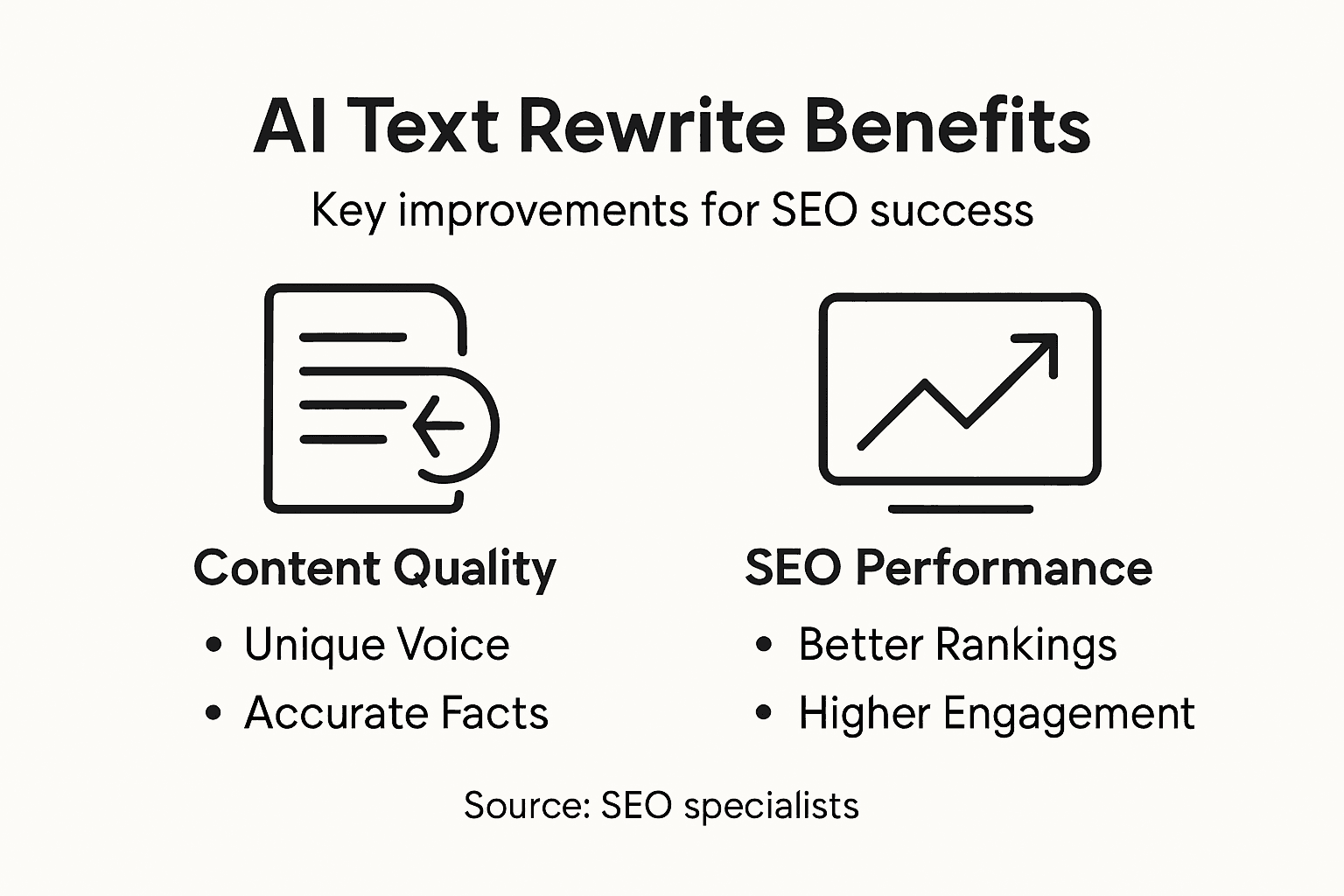
Here’s a quick overview of how human review enhances AI-generated content:
| Enhancement Area | AI-Only Text Result | Human-Refined Text Result |
|---|---|---|
| Emotional Tone | Often flat or mechanical | Resonates emotionally with readers |
| Audience Relevance | May miss target interests | Tailored to audience needs |
| Clarity & Flow | Predictable, repetitive | Smooth transitions, improved flow |
| Brand Voice | Generic phrasing | Unique style and brand alignment |
Pro tip: Always allocate time for comprehensive human review and thoughtful refinement when working with AI-generated content.
Key Limitations of Raw AI Content
Artificial intelligence has transformed content creation, but raw AI-generated text comes with significant inherent limitations that challenge its reliability and effectiveness. While AI can produce text rapidly, it fundamentally lacks the nuanced understanding and contextual depth that human writers bring to communication.
The primary limitations of unedited AI content include:
- Lack of Contextual Nuance: Inability to capture subtle cultural, emotional, and situational contexts
- Potential Factual Inaccuracies: Tendency to generate plausible-sounding but potentially incorrect information
- Repetitive Language Patterns: Generating text with predictable structures that feel mechanical
- Limited Original Thinking: Challenges in intellectual contribution and genuine creative insight
AI language models operate by predicting statistically likely word sequences, which means they can produce grammatically correct text that fundamentally lacks genuine understanding. This computational approach means AI frequently generates content that sounds superficially coherent but fails to demonstrate true comprehension of the subject matter.

Moreover, AI-generated content often struggles with maintaining a consistent tone, understanding complex rhetorical strategies, and adapting to specific audience needs. Professional writers recognize these limitations and understand that AI should be viewed as a collaborative tool rather than a complete content solution. The most effective content strategies involve using AI as a initial draft generator, followed by comprehensive human refinement and strategic editing.
Pro tip: Always cross-reference AI-generated content against multiple authoritative sources to verify factual accuracy and contextual relevance.
Humanizing Content for Audience Connection
Connecting with readers goes far beyond grammatical correctness—it requires transforming AI-generated text into a narrative that resonates emotionally and intellectually. Audience connection demands more than algorithmic precision; it necessitates understanding human experiences, emotions, and communication nuances that AI inherently struggles to replicate.
The core strategies for humanizing content involve:
- Injecting Personal Perspective: Adding authentic storytelling elements and personal insights
- Emotional Language Adaptation: Incorporating conversational tones and empathetic expressions
- Context-Specific Refinement: Tailoring content to specific audience demographics and interests
- Cultural Sensitivity: Bridging automated text with human experiences through contextual understanding
Successful humanization requires writers to deconstruct AI-generated text and rebuild it with genuine human touch. This process involves carefully examining each paragraph for mechanical language patterns, replacing robotic phrasing with natural, engaging expressions that reflect real-world communication styles. The goal is not just grammatical correction but creating a sense of authentic connection that makes readers feel understood.
Professional content creators recognize that true audience engagement stems from vulnerability, relatability, and genuine communication. AI can provide a structural foundation, but human intervention transforms cold, computed text into compelling narratives that spark emotion, provoke thought, and create meaningful connections. By strategically rewriting AI drafts, writers can breathe life into machine-generated content, ensuring it speaks directly to human experiences and perspectives.
Pro tip: Read your rewritten content aloud to ensure it sounds natural and conversational, capturing authentic human communication rhythms.
SEO Performance and Bypassing AI Detectors
Navigating the complex landscape of SEO requires more than traditional optimization strategies—it demands sophisticated content transformation techniques that can outsmart increasingly advanced AI detection mechanisms. Search engine algorithms are becoming more nuanced in identifying machine-generated content, making strategic rewriting an essential skill for digital content creators.
Key strategies for improving SEO and bypassing AI detectors include:
- Contextual Language Modification: Introducing unique semantic variations
- Natural Language Patterns: Incorporating conversational and contextually appropriate phrasing
- Semantic Diversity: Creating text with unpredictable linguistic structures
- Reducing AI Detection Accuracy: Implementing strategic text transformations
Successful content rewriting goes beyond simple word substitution. Professional content strategists understand that effective AI content bypass requires a deep understanding of linguistic nuance, search engine ranking factors, and audience engagement metrics. The goal is not merely to evade detection but to create genuinely valuable, human-like content that resonates with readers and meets algorithmic quality standards.
Moreover, the emerging landscape of AI content detection demands continuous adaptation. Search engines and AI detection tools are rapidly evolving, creating a dynamic environment where content creators must consistently refine their approaches. By developing sophisticated rewriting techniques that maintain the core message while introducing human-like complexity, writers can create content that seamlessly navigates both algorithmic scrutiny and reader expectations.
Pro tip: Regularly update your rewriting strategies by studying the latest AI detection methodologies and linguistic variation techniques.
Risks of Unedited AI Content in Practice
The digital content landscape is fraught with potential pitfalls when organizations blindly rely on unedited AI-generated text. Unverified AI outputs can introduce significant risks that extend far beyond simple grammatical errors, potentially compromising professional credibility, intellectual integrity, and strategic communication objectives.
The most critical risks of unedited AI content include:
- Factual Inaccuracies: Generating plausible-sounding but fundamentally incorrect information
- Plagiarism Concerns: Unintentionally reproducing existing content without proper attribution
- Algorithmic Bias: Perpetuating problematic linguistic patterns and potentially discriminatory language
- Compromising Research Integrity: Creating potentially unreliable scholarly communications
Professional content creators recognize that AI-generated text represents a raw computational output, not a finished product. The technology, while sophisticated, lacks the nuanced understanding of context, cultural sensitivity, and critical reasoning that human writers bring to communication. Unedited AI content can introduce subtle yet significant errors that may undermine an organization’s credibility, misrepresent complex ideas, or fail to connect authentically with target audiences.
Moreover, the rapid evolution of AI detection technologies means that unedited machine-generated content becomes increasingly identifiable, potentially triggering algorithmic penalties in search rankings and diminishing content visibility. Organizations that fail to implement rigorous human review and strategic rewriting risk not just reputational damage, but also reduced digital marketing effectiveness and audience engagement.
Pro tip: Implement a mandatory human review process for all AI-generated content, treating machine outputs as initial drafts rather than final deliverables.
Comparing AI Rewriting Tools and Methods
The landscape of AI rewriting tools has rapidly evolved, offering content creators increasingly sophisticated options for transforming machine-generated text. Rewriting technologies now represent a complex ecosystem of tools with distinct capabilities, each designed to address specific content enhancement challenges.
Key comparative aspects of AI rewriting tools include:
- Lexical Diversity: Ability to generate varied linguistic expressions
- Semantic Accuracy: Maintaining original meaning while modifying text structure
- Grammar Correction: Ensuring grammatical precision and coherence
- Comparative Tool Performance: Evaluating different platforms’ strengths and limitations
Professional content strategists understand that no single AI rewriting tool offers a universal solution. Each platform demonstrates unique strengths, from QuillBot’s flexible rephrasing capabilities to Grammarly’s robust grammar correction features. The most effective approach involves understanding each tool’s specific capabilities and selecting the right technology for particular content requirements.
Compare the most popular AI rewriting tools and their strengths:
| Tool Name | Best For | Drawback | Unique Strength |
|---|---|---|---|
| QuillBot | Creative rephrasing | Occasional loss of nuance | Multiple rewrite modes |
| Grammarly | Grammar correction | Limited semantic change | Real-time error detection |
| Wordtune | Clarity improvements | Less customization | Intuitive user suggestions |
| Jasper | Bulk content automation | May over-automate style | Versatile content templates |
Moreover, successful AI content rewriting demands a nuanced approach that goes beyond simple tool selection. Effective rewriting requires human oversight, critical evaluation, and a deep understanding of contextual subtleties that automated systems cannot fully comprehend. Content creators must view AI rewriting tools as collaborative technologies that augment human creativity rather than replace it entirely.
Pro tip: Experiment with multiple AI rewriting tools and develop a personalized workflow that leverages each platform’s unique strengths.
Unlock the Power of Humanized and SEO-Optimized AI Content with Hukhta
The challenge of rewriting AI-generated text for better SEO lies in transforming mechanical, repetitive language into authentic, engaging content that connects emotionally with your audience while outsmarting AI detection tools. If you struggle with preserving originality, maintaining brand voice, or enhancing readability to improve search rankings, Hukhta.com offers the solution you need. Our AI-powered platform specializes in rewriting, humanizing, and summarizing machine-generated content to deliver natural, contextually relevant, and SEO-friendly copy tailored for marketing, blogging, academic writing, and more.
By leveraging Hukhta’s advanced paraphrasing and content enhancement features, you can address key pain points highlighted in the article such as reducing robotic phrasing, injecting emotional tone, and verifying factual accuracy. Our intuitive platform supports over 120 languages and streamlines content workflows so you save time while boosting engagement and authenticity.
Ready to elevate your AI-generated text into compelling, human-like content that excels in SEO? Try Hukhta now and experience how effortless content rewriting can enhance your digital strategy.
Discover how easy it is to transform your content at Hukhta.com. Visit our platform and start rewriting your AI text with precision and creativity today. Don’t let robotic content hold back your SEO potential. Act now to create genuinely engaging content that resonates with your audience and ranks higher.
Frequently Asked Questions
Why is it important to rewrite AI-generated texts?
Rewriting AI-generated texts enhances quality, improves SEO performance, maintains authenticity, and addresses ethical concerns, ensuring that the final content resonates with readers and meets search engine standards.
How can rewriting AI content improve SEO?
Rewriting transforms generic AI outputs into optimized content by incorporating unique semantic variations, natural language patterns, and engaging structures that search engine algorithms favor, ultimately improving visibility and ranking.
What are the key limitations of raw AI-generated content?
Raw AI-generated content often lacks contextual nuance, can contain factual inaccuracies, exhibits repetitive language patterns, and shows limited original thinking, making human oversight essential for quality communication.
What strategies can I use to humanize AI-generated content?
To humanize AI-generated content, consider injecting personal perspectives, using emotional language, tailoring content to specific audiences, and ensuring cultural sensitivity to create authentic and engaging narratives.